


Reduce Database Bloat: Data Compression & Optimization for Microsoft Dynamics NAV/BC
For Microsoft Dynamics NAV/BC teams researching data compression Business Central options, the problem is familiar: years of item ledger entries: years of item ledger entries, posted sales invoices, credit memos, purchase documents, transfer orders, and shipments just keep accumulating, quietly inflating the database and slowing everything down. Older versions of Dynamics NAV shipped with a native Item Ledger Entry compression tool. Business Central dropped it.
Acumens Item Ledger Compression (NW) brings that missing capability back — and extends it further than the old NAV tool ever went.
What it actually does
The app works on two fronts:
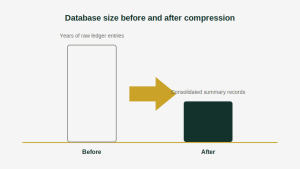
– Item Ledger Compression — combines historical item ledger entries into summarized records based on schedules and cut-off dates you define, while preserving the totals and data integrity needed for reporting.
– Posted Documents Compression — applies the same controlled, cut-off-based compression to posted sales, purchase, transfer, and shipment documents that are no longer needed for daily operations but still take up space.
Both run on a schedule, not a one-time cleanup — so the database stays lean as a matter of routine rather than requiring periodic manual intervention.
Why this matters beyond just disk space
– Faster system performance. Smaller tables mean faster queries, faster reports, and a more responsive Business Central instance overall — especially noticeable for companies with years of transaction history.
– Audit and reporting integrity preserved. Compression is designed to retain what auditors and finance teams actually need, not just shrink numbers indiscriminately.
– Visibility into what’s been compressed. Logging and execution tracking give you a clear record of compression activity — useful both for internal governance and for explaining to an auditor exactly what happened to older entries.
– Set it and let it run. Once schedules and cut-off dates are configured, there’s no manual database housekeeping required.
Who feels this the most
Data compression Business Central solutions like Acumens Item Ledger Compression are becoming standard practice for companies running Business Central at scale — retail, distribution, manufacturing — are the ones most likely to notice both the problem (sluggish performance, ballooning database size) and the relief once compression is in place.
How this differs from Business Central’s native database tools
Business Central does offer some native ways to manage database size — Microsoft’s own documentation outlines deleting unused companies, deleting old documents outright, setting up retention policies, and enabling table-level or database-level compression via the CompressionType property or the Start-NAVDatabaseCompression cmdlet.
These tools are useful, but they solve a different problem than item ledger compression does:
– Retention policies delete data. They’re built for outdated log entries and archived records you’re comfortable losing permanently.
– Table compression is physical, not structural. SQL-level compression packs the same number of rows more efficiently on disk — it doesn’t reduce how many item ledger entries or posted documents exist.
– Deleting documents removes history entirely. Fine for records with no ongoing value, but not an option when audit or reporting requirements mean you need to retain summarized history.
Acumens Item Ledger Compression (NW) fills the gap between these: it consolidates historical item ledger entries and posted documents into fewer, summarized records — shrinking the database while preserving the totals auditors and finance teams still need. It’s also, notably, reintroducing functionality Business Central had in earlier Dynamics NAV versions and later removed — Microsoft’s native compression tools were never a replacement for it.
Pairs well with Receivables Management and Subscription & Maintenance Fee Billing for keeping your Business Central database lean across the board
FAQ
Does Business Central support item ledger compression natively?
Business Central offers native database tools—table-level and database-level compression, retention policies, and manual document deletion (see Microsoft’s documentation)—but the specific item ledger entry consolidation functionality available in earlier Dynamics NAV versions was removed and isn’t part of these native tools. Acumens Item Ledger Compression reintroduces it, with configurable cut-off periods and schedules.
Can I reduce database size caused by years of historical records?
Yes. Item ledger entries, invoices, credit memos, transfer orders, and posted shipments can all be compressed on a defined schedule, reducing storage needs while keeping what you need for audits and reporting—without the all-or-nothing tradeoff of deleting documents outright.
Can posted documents be compressed too, not just ledger entries?
Yes — standard Business Central can’t compress historical posted documents at the entry-consolidation level. This app handles that separately, on its own cut-off logic.