

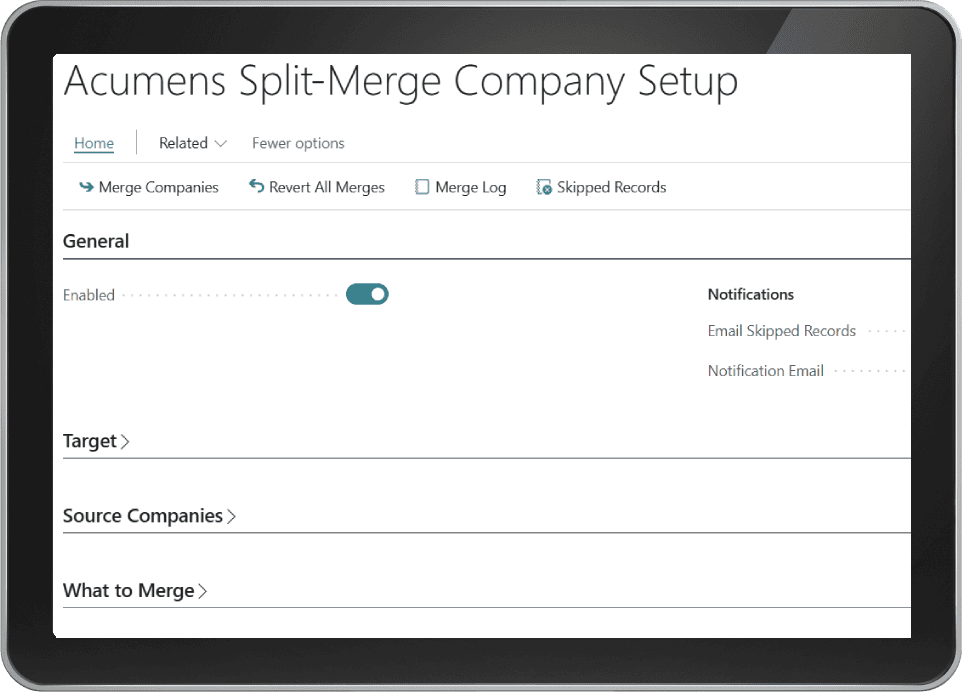
Acumens Split-Merge Company
Acumens Split-Merge-Copy Companies App is a comprehensive Microsoft Dynamics Business Central extension designed to streamline multi-company administrative management. Integrating specialized data consolidation software capabilities allows enterprise organizations to merge multiple companies into a single entity to consolidate operational data, split one company into several based on defined business rules, or copy an existing company specified dataset into another for rapid setup when launching new enterprise entities.
Managing multi-entity corporate structures without automated data transfer mechanisms introduces administrative friction, duplicate master records, and reporting delays. Streamlining entity consolidation directly inside core ERP modules ensures complete financial transparency, eliminates manual data entry errors, reduces operational overhead, and maintains strict compliance and full auditability across all active corporate subsidiaries.
Table of Contents
Key Features
Deploying enterprise data consolidation software capabilities inside Business Central provides three primary execution modes tailored to complex corporate restructurings:
1. Multiple Source Companies to One Target Company: Consolidate financial and operational records from several distinct source companies into a single unified target entity without manual ledger exports.
2. Flexible Merge Types:
The app supports two distinct merge routines. First, a Full Merge performs a clean migration by deleting previously merged rows before executing the re-merge process. Second, a Differential Merge copies only the newest records that have not yet been merged from each source company.
3. Advanced Merge Options:
System administrators can select precise record mapping logic. The standard Merge option updates existing records or creates missing entries using the original Source No. The Create New option uses the Source No for the first instance while creating prefixed duplicates for subsequent matches. Finally, the Create New with Prefix option prefixes every incoming record with the Source Company Code to preserve origin identity.
Implemented For Master Records
Utilizing robust data consolidation software routines ensures seamless data transfer across all essential master record ledgers, including General Ledger (G/L) Accounts, Customers, Vendors, Items, Resources, and Fixed Assets.
Furthermore, critical shared organizational features merge automatically alongside primary master records. The system seamlessly consolidates Default Dimensions, Dimension Set Entries, and historical Value Added Tax (VAT) Entries to maintain consistent reporting parameters across consolidated entities.
Streamlining Multi-Entity Business Central Workflows
Managing multi-company operations manually across distinct ERP environments introduces severe data fragmentation, duplicate vendor profiles, and month-end closing delays. Deploying automated data consolidation software tools directly inside Business Central eliminates redundant administrative tasks by standardizing ledger structures, customer profiles, inventory catalogs, and global dimension values across parent and subsidiary organizations.
Whether rebalancing corporate structures during corporate mergers, restructuring regional business units through enterprise splits, or spinning up fresh template environments for new branch locations, automated data migration safeguards historical financial integrity. Controllers maintain complete auditability over G/L account mappings, transaction histories, and tax alignment without risking system downtime or data corruption.
Centralizing multi-entity data management simplifies consolidated financial reporting, accelerates audit preparations, and ensures total operational compliance across all expanding corporate subsidiaries. Systems teams can configure automated scheduled runs to process large datasets overnight, eliminating bottleneck issues during business peak operational hours.
Implementing structured entity management empowers financial executives to maintain centralized control while providing localized operational autonomy to regional business divisions worldwide. Modern enterprises rely on these robust tools to drive continuous scalability, secure compliance, and smooth organizational transitions.
Driving Scalable Corporate Governance
Deploying reliable data consolidation software inside Business Central empowers enterprise financial leaders to scale multi-company architecture effortlessly.
For more details, check our guide on Acumens History Management or read official documentation on Microsoft Dynamics 365 Architecture Models.